There’s a reason vines wrapped around arm tattoos keep showing up on best-of lists and studio portfolios year after year. It’s not trend-chasing. It’s anatomy. The arm is a curved, three-dimensional surface, and vines are nature’s answer to exactly that kind of shape. They don’t fight the contours of the body — they follow them. Wrap a well-designed vine around a forearm or bicep, and the result looks less like something applied to the skin and more like something that grew there.
Ornamental tattooing has always understood this. So has botanical illustration, blackwork, Irezumi, and just about every other serious tattooing tradition. Which is why the vine-wrapped arm appears across so many different styles without ever feeling like the same tattoo twice. A single-needle ivy band and a bold blackwork geometric piece share almost nothing technically, but both work for the same fundamental reason: the designs move with the arm rather than sit flat on it.
These twenty vines wrapped around arm tattoo ideas cover the full range of what’s possible when a skilled artist takes this concept seriously. Fine-line minimalism, surrealist fantasy, trompe l’oeil illusion, botanical illustration so precise it looks printed. Something here will resonate. All of them are worth knowing about.
1. Tiny Fine-Line Ivy and Oak
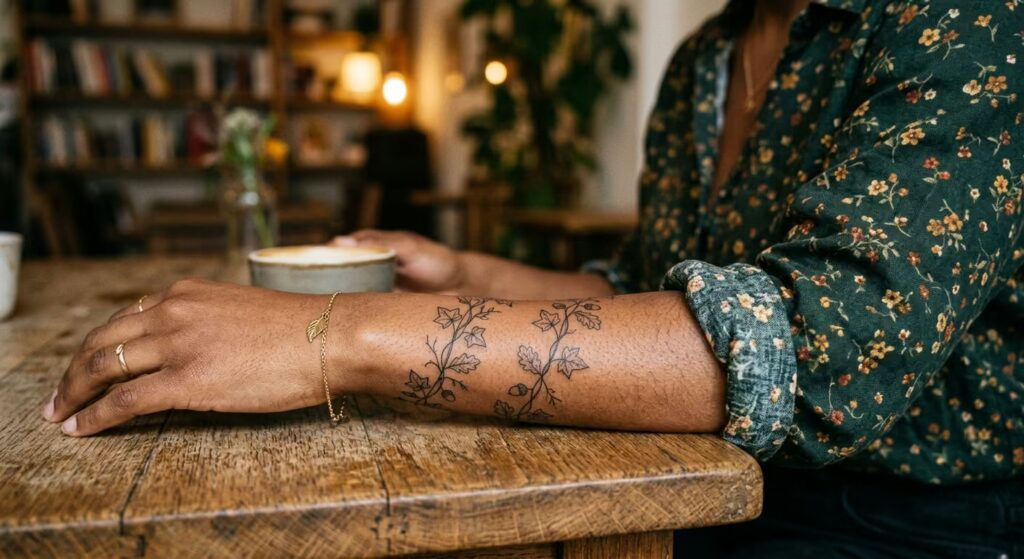
The quiet one on this list, and deliberately so. Intertwined ivy and oak rendered in delicate fine-line work, resting on the arm like something discovered rather than designed.
Ivy for endurance, oak for strength — two plants that have been saying those things for centuries without needing anyone to explain them. The restraint of the technique is the whole point here. Sometimes, the most confident vines wrapped around arm tattoo design choice is knowing exactly when to stop.
2. Minimalist Single-Line Grapevine
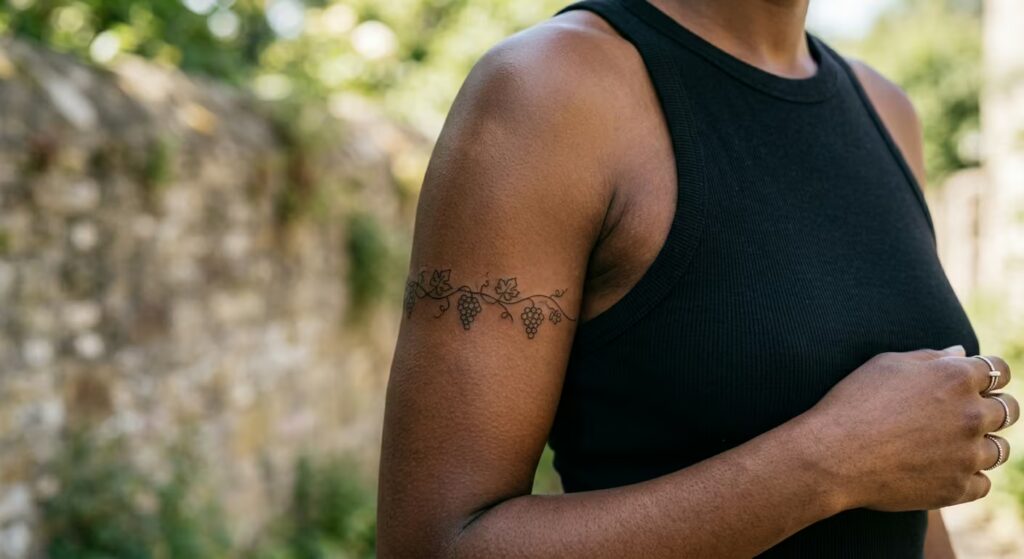
A continuous single line forming grape clusters and winding tendrils with no breaks and no second chances — the kind of tattooing that looks effortless and is anything but. The grapevine has a warmth to it that more architectural botanical choices don’t always carry.
Something abundant and a little celebratory. The single-line technique keeps it from tipping into sentimentality and lands it somewhere clean and genuinely modern instead.
3. Textured Stipple Wild Rose Wrapped Around Arm Tattoo
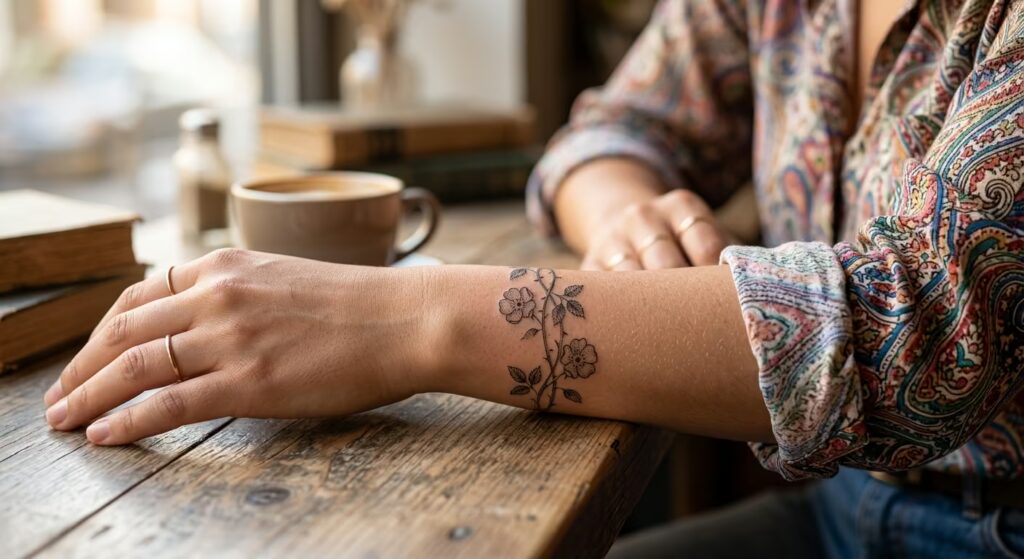
Dotwork changes what’s possible with thorned plants. Instead of the hard, graphic quality that line work gives roses and brambles, stipple shading makes them feel organic and a little dangerous in the right way.
Tiny black roses, intricate leaves, and thorny vines encircling the forearm near the wrist with a texture that shifts depending on the light. This one rewards close attention. The further in you look, the more the dots resolve into something remarkable.
4. Cross-Hatching Jungle Monstera and Ferns
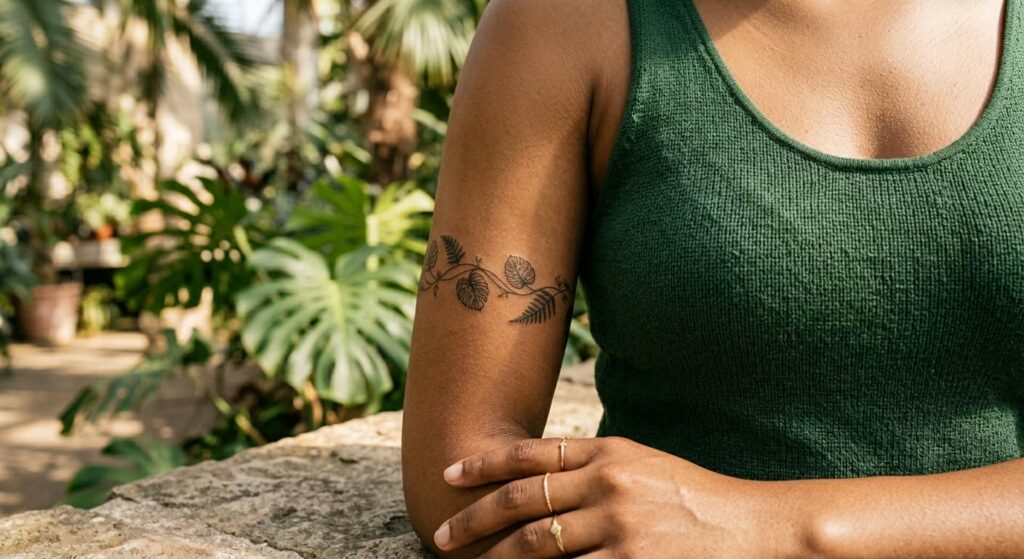
Deep cross-hatching is one of those techniques that announces itself confidently and then backs it up completely. Bold texture, strong contrast, a design that reads clearly from across the room, and holds up just as well up close.
Monstera leaves and fern fronds in sharp black ink on the bicep, with a low-angle perspective that emphasizes the arm’s own structure. This is a vines wrapped around arm tattoo that leans into strength rather than delicacy, and it wears accordingly.
5. Ornamental Fine-Line Cherry Blossom
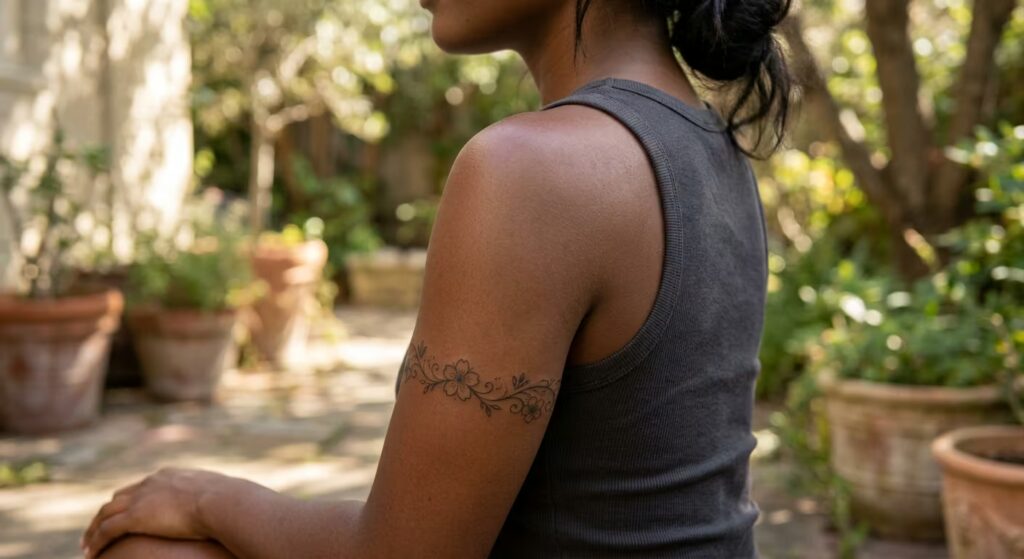
Cherry blossoms get used a lot in tattooing, which means the vine tattoo design has to work harder to stand out. This one earns its place through the ornamental approach — stylized black blossoms woven with scrollwork tendrils that give the familiar flower a structural elegance it doesn’t always have.
The dotwork detailing adds depth without adding visual noise. Captured over the shoulder looking down, it sits above the bicep like something that was always supposed to be exactly there.
6. Blackwork Geometric Hops and Barley
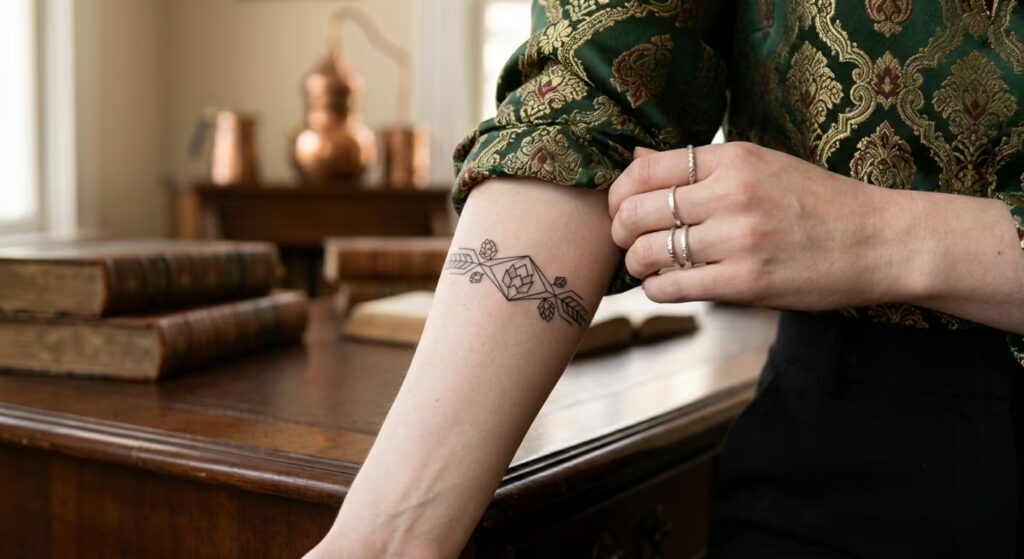
The most unexpected pairing on this list, and one of the most interesting. Hops and barley are not obvious tattoo subjects, but rendered in interlocking geometric facets with precise all-black shading they become something genuinely striking.
The angularity of the geometric forms plays against the organic nature of the plants in a way that creates real tension. Sharp, modern, and specific in a way that sets it apart from every other botanical vine piece you’ve seen.
7. Sticker Style Bramble and Blackberry
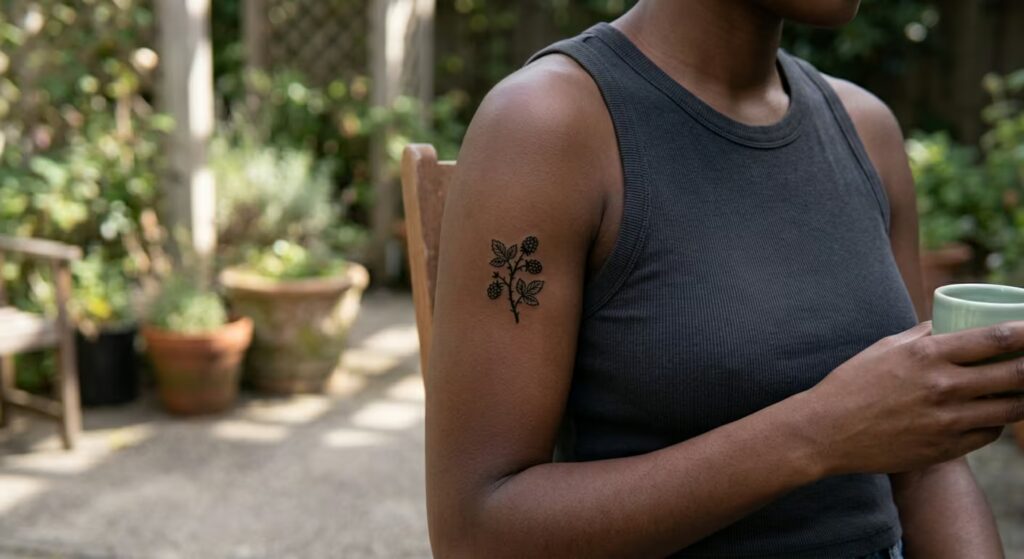
Bold, clean-edged, unambiguous. The sticker aesthetic has been building momentum in tattooing for good reason — the commitment to solid black and clean outlines makes for pieces that age exceptionally well and read with real confidence.
Blackberry fruits and thorny leaves encircling the bicep near the armpit, a side-profile placement that turns the arm itself into part of the composition. Defiant in the best possible way. No apologies, no softening, just a great design executed cleanly.
8. Micro-Realistic Elven Woodland Vine Tattoo
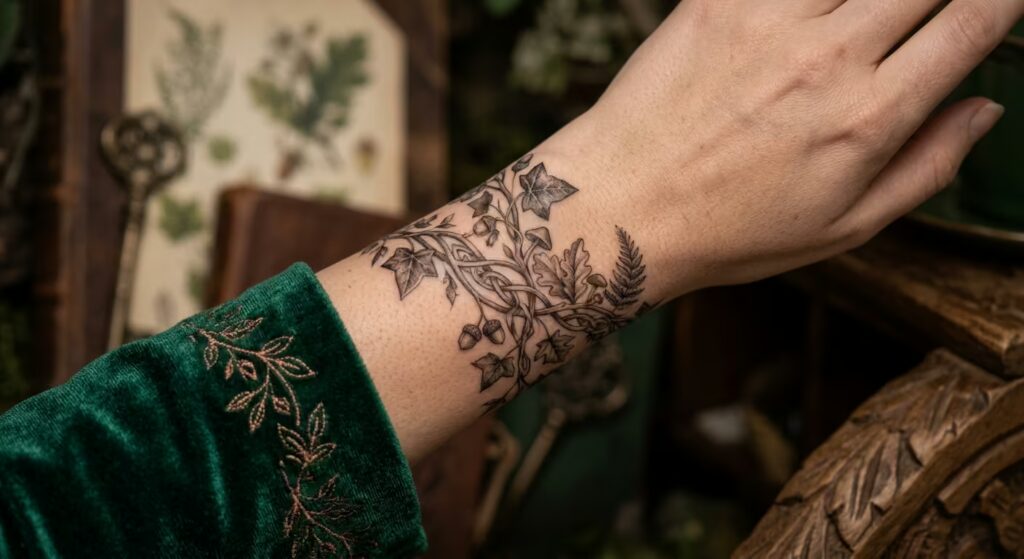
Oak, ivy, ferns, acorns, and tiny mushrooms rendered in micro-realistic black and grey shading on the forearm, wrapping like a natural cuff. The detail required to pull this off at small scale is considerable — light and shadow compressed into a space where every decision is visible and nothing can be fudged.
When it works, as it does here, the result is genuinely magical in quality. It pairs with an emerald green velvet sleeve in the reference image and looks like it belongs in a different world entirely, which is precisely the point.
9. Surrealist Driadic Roots and Branches
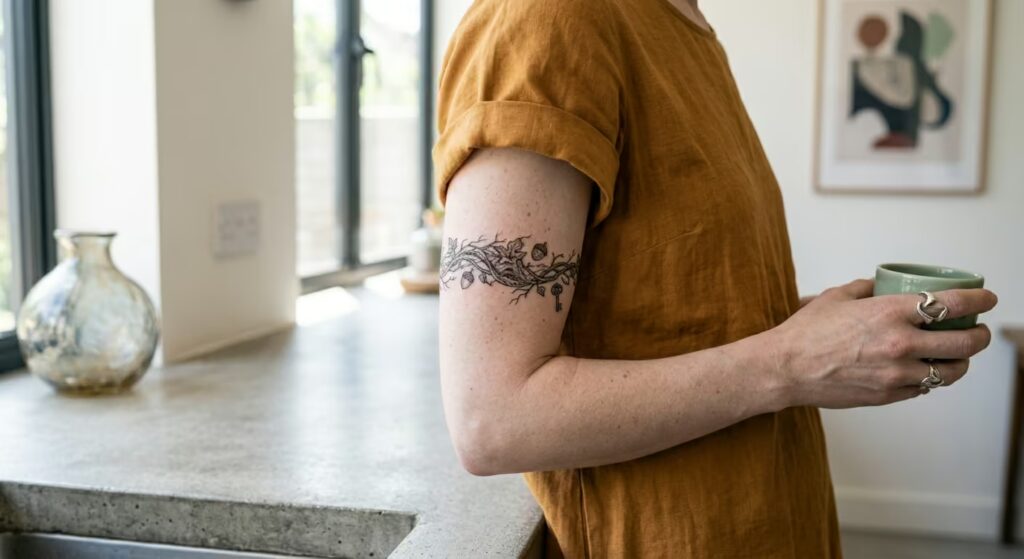
Impossible roots, winding branches, a bark face emerging from the design, floating acorns, celestial charts, and a root that terminates in a detailed key. This is surrealism applied to botanical tattooing with complete commitment, and it results in something that exists in its own visual category.
Fine-line work this precise on a pale upper bicep looks less like a tattoo and more like an illustration that somehow ended up on skin. For the person who wants their arm to tell a story nobody else is telling, this is it.
10. Trompe L’Oeil Dragon and Vine Tattoo
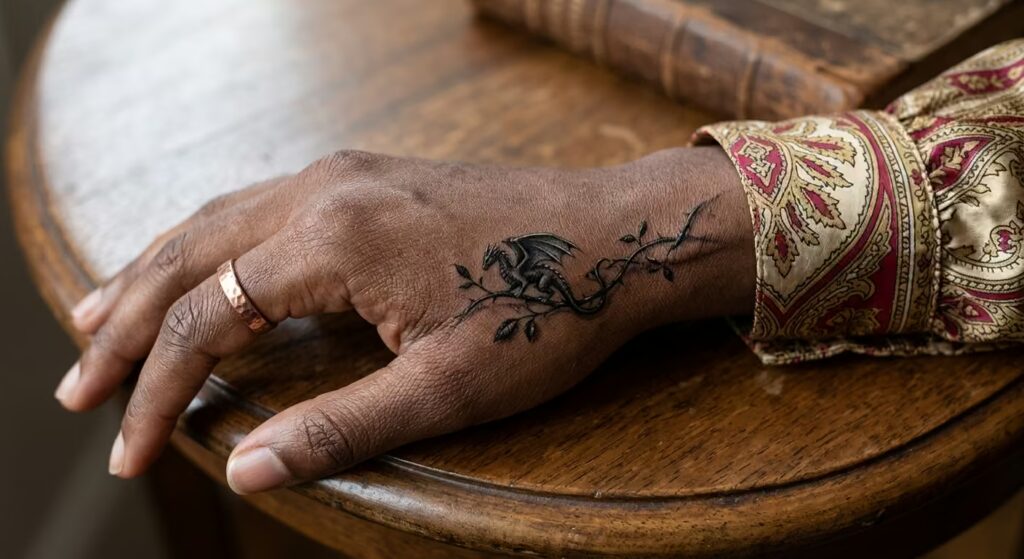
A tiny black-ink dragon with detailed wings and scales resting on a winding vine, internal shading and minute highlights creating a genuine three-dimensional illusion on the hand and wrist.
Trompe l’oeil at micro-scale is one of the more demanding things a tattoo artist can attempt — the margin for error is essentially zero. When it lands, it creates the kind of double-take that makes people reach for your hand to look more closely. This one lands.
11. Botanical Illustration Deadly Nightshade

Rendered in strict botanical illustration style, this tiny band of deadly nightshade features menacing thorns, dark berries, and contorted leaves with pseudo-diagrammatic symbols of poison worked into the design. It looks like something lifted directly from a vintage engraved plate.
There’s a dark humor to wearing something this beautiful and this lethal on your forearm, and the botanical illustration style leans into that contradiction perfectly. For anyone who loves the aesthetics of natural history but wants the subject matter to have a little menace.
12. Micro-Whip Shading Wisteria Tendrils
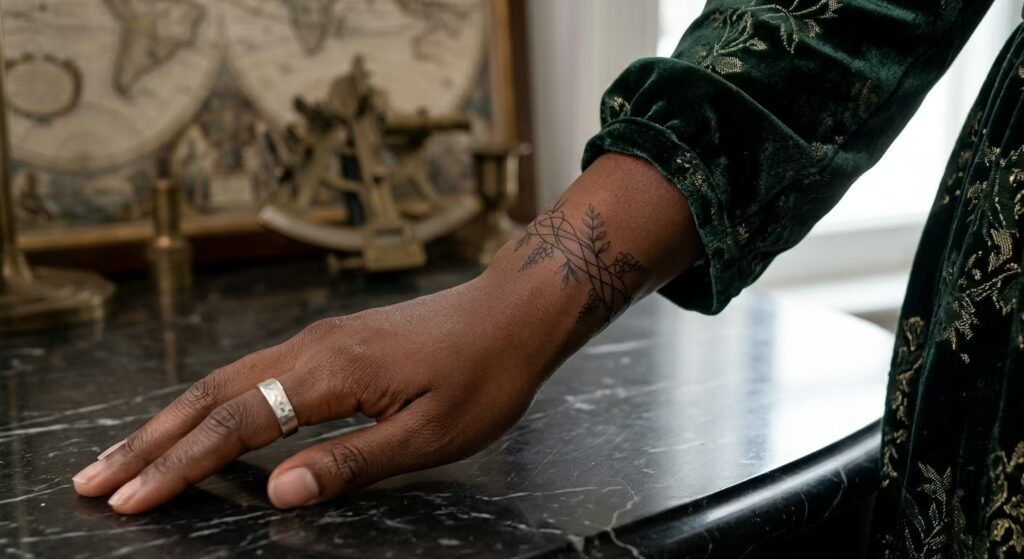
Micro-whip shading is a technique that creates gradient depth without the mechanical uniformity of dotwork — the effect is softer, smokier, more atmospheric.
Delicate black tendrils and microscopic wisteria blossoms wrap around the forearm with stippled shading that gives the whole piece a dreamy quality. Opulent is the right word. It’s the most overtly romantic vine tattoo design on this list, and it commits to that completely, which is why it works.
13. American Traditional Mythical Fruit Vine Tattoo
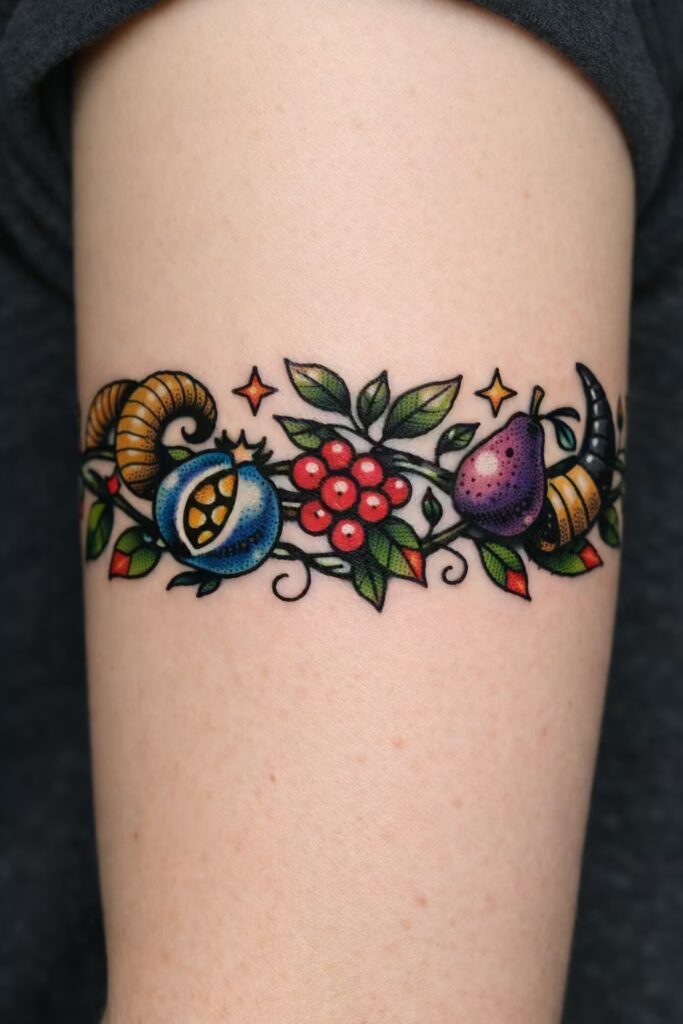
Traditional style at small scale requires genuine skill because the conventions of the genre — bold lines, stipple texture, clear graphic forms — don’t compress easily. When an artist gets it right, the result has an authority that no other style quite replicates.
Mythical fruit, leaves, and horns in a dainty traditional execution, demonstrating that bold doesn’t have to mean large and that traditional motifs have more range than they’re always given credit for.
14. Irezumi Nymph’s Embrace Vine Tattoo
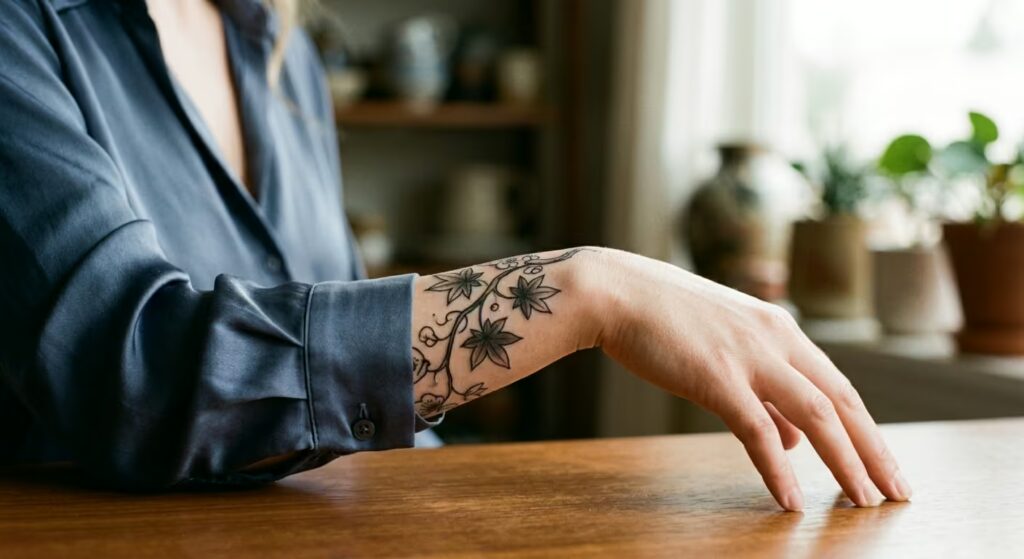
Maple leaves, delicate plum blossoms, and stylized nature spirit symbols in abstract fluid Irezumi style wrapping around the forearm. The Irezumi tradition has its own deeply developed visual language around nature, flow, and the relationship between the human body and the natural world.
A vine-wrapped arm is in genuine dialogue with that tradition rather than just borrowing its aesthetics. The result feels earned rather than appropriated, and the movement in the design is extraordinary.
15. Celtic Knotwork Vine Band

Celtic knotwork integrated with sinuous vine motifs in a narrow band around the upper bicep, with a hand-drawn illustrative sketch quality that keeps it from feeling rigid. The knotwork within the vine tattoo forms is intricate enough to reward a close look without overwhelming the arm.
Sun-dappled and rendered in a rustic garden setting in its reference image, it has a warmth that more technically precise interpretations of Celtic work don’t always carry. Timeless without being static.
16. Graphic Novel Healing Vine Tattoo

Graceful vines, leaves, small buds, and integrated sparkle icons in a distinct graphic novel line style on the inner forearm. The sparkle elements are what lift this from straightforward botanical into something more playful and contemporary.
They read as a deliberate aesthetic choice rather than decorative filler. For anyone who grew up with illustrated fiction and wants their tattoo to carry that visual language, this is a confident way to do it.
17. Cel-Shaded Infinity Loop Vine Tattoo
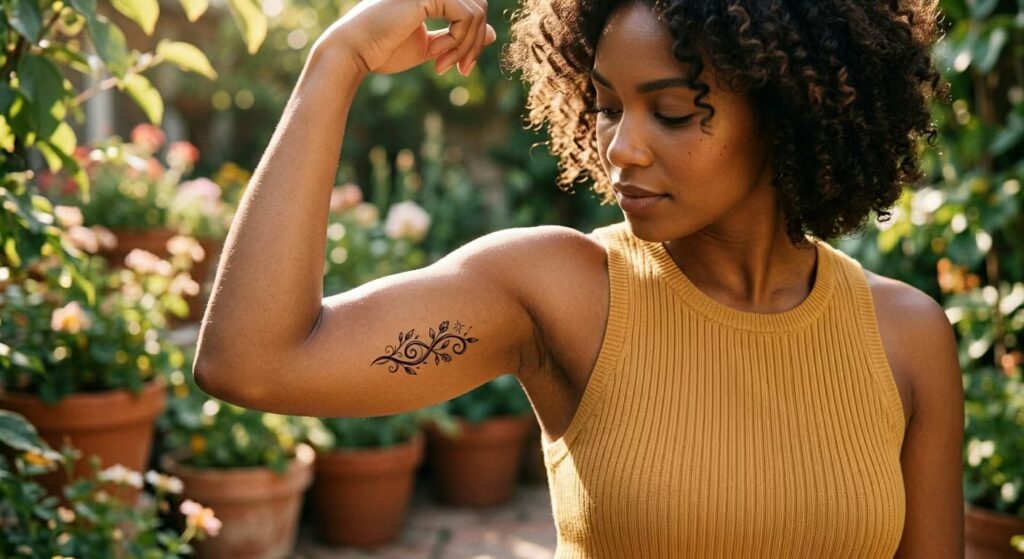
A continuous vine integrated into a clear infinity loop symbol, complete with small leaves and floral details in clean cel-shaded illustrative lines. The infinity symbol is genuinely difficult to make interesting at this point, but treating it as a structural element for the vine rather than a standalone symbol gives it new purpose. Small and precise and quietly clever. The kind of tattoo that makes people ask who did it.
18. Trash Polka Compass and Vine Tattoo
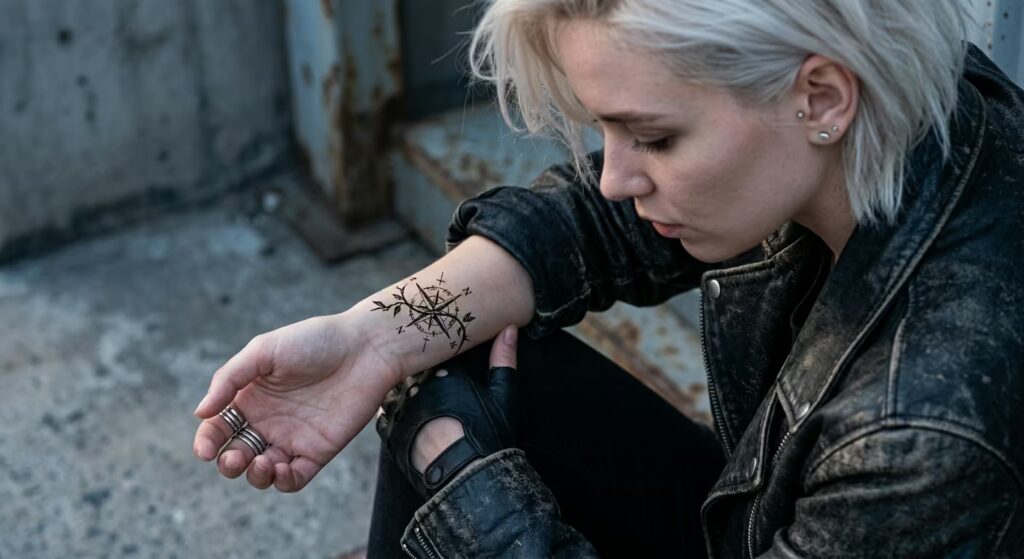
A fragmented compass rose with abstract geometric crosshairs and directional markers, integrating a single angular stylized vine in the collage-like trash polka aesthetic. This is the outlier on the list in the best possible way.
Trash polka is a polarising style — you either connect with its gritty, fragmented visual logic or you don’t — but at this small scale on the outer wrist it demonstrates something important: the style’s energy doesn’t require large format to be effective. Big impact from minimal real estate.
19. Fluid Barbed Wire and Rose Vine Tattoo

Barbed wire and roses are one of those classic pairings that has to be handled carefully to avoid feeling dated. The abstract fluid approach here is what saves it — the barbed wire loses its rigidity and intertwines with the rose vines in a way that feels genuinely organic rather than confrontational.
Hard and soft, dangerous and beautiful, balanced into something that flows around the bicep with real grace. The tension in the concept becomes the tension in the design, and it earns it.
20. Dotwork Autumn Leaf Vine Tattoo
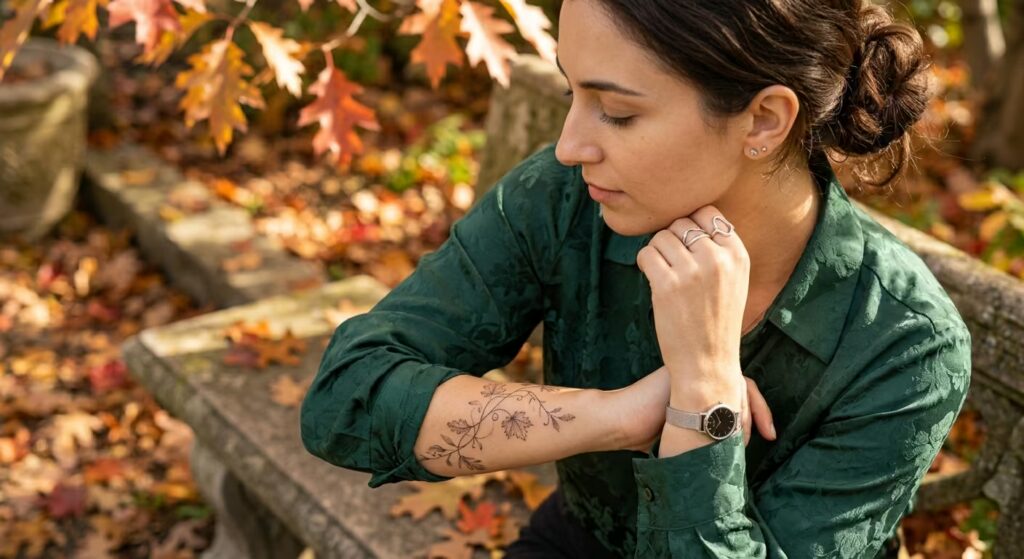
Oak and maple leaves in meticulous black dotwork, interwoven with flowing vines around the forearm in a sun-dappled autumn setting. Pointillism at this scale requires patience from both the artist and the person in the chair, and the results justify every minute of it.
The seasonal specificity of this vine tattoo design gives it a warmth that more abstract botanical choices don’t always carry. A reminder that sometimes the most straightforward subject matter, executed with complete technical commitment, produces the most lasting piece.
Why Does the Arm Keep Earning This?
The vine-wrapped arm endures as a concept because it solves a genuine design problem. The arm moves constantly. It rotates, flexes, catches light differently throughout the day. A tattoo that ignores this, that treats the arm as a flat surface to print onto, will always look like exactly that. A vine tattoo that follows the arm’s own logic, that wraps and curves and flows with the body’s natural geometry, looks like it belongs.
The twenty vine tattoo designs on this list approach that problem from entirely different directions. Some solve it with the organic looseness of fine-line botanical work. Others solve it with the geometric precision of blackwork. A few solve it with the visual storytelling of surrealism or the atmospheric depth of micro-realism. The technique varies enormously. The underlying understanding of what the arm needs from a tattoo does not.
Whatever style resonates, find an artist who specializes in it. The vine-wrapped arm at its best is a collaboration between a great vine tattoo design and a great understanding of the body it’s on. Get both right, and you’ll have something genuinely worth wearing.