
When it comes to cardio workouts, two machines dominate home fitness spaces and gyms: the treadmill and the elliptical. Both are incredible tools for burning calories, improving cardiovascular health, and losing weight. However, the two machines work the body in different ways. Although they share similarities, they also differ.
So, between an elliptical machine and a treadmill, which is better? The answer depends on your physical condition, fitness goals, personal preferences, and many other factors. Keep reading to know which is a better fit for you.
What is an Elliptical Machine?
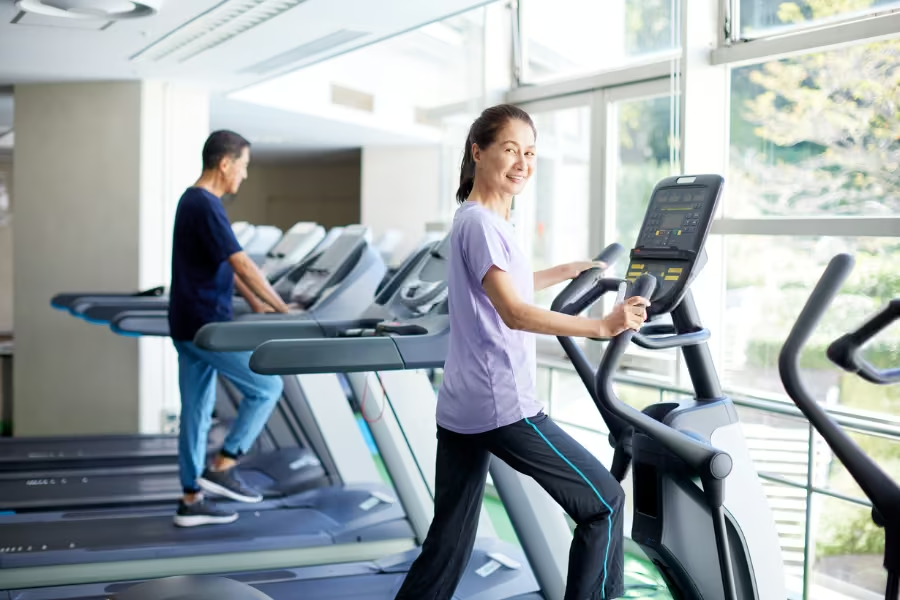
Also known as a cross-trainer, it is a stationary exercise machine that mimics running, climbing stairs, and walking without putting pressure on your joints. It enables you to move your feet in an oval path. An elliptical is fitted with moving handlebars that help keep your upper and lower bodies engaged simultaneously.
Parts of an Elliptical
When you understand the components of an elliptical, it will be easy to use the machine effectively. Here are the parts of an elliptical:
- Foot Pedals
These are large platforms where you rest your feet. In some models, you will find incline and stride adjustments.
- Handlebars
An elliptical can be fitted with either moving or fixed handlebars. Handlebars are used to provide stability, versatility, and targeted training.
- Resistance Controls
Resistance controls are fitted in an elliptical to help you adjust the levels of peddling.
- Display/Console
The machine has a display that shows metrics such as:
- Speed
- Time
- Distance covered
- Heartrate
- Calories burned.
- Flywheel
Most ellipticals have a flywheel weighing between 15 and 30+ pounds. The purpose of the flywheel is to act as the core component for generating momentum, ensuring the pedals move in a smooth, consistent motion rather than a shaky one.
- Pedals
This is where you place your feet. Most pedals are cushioned and adjustable to provide more comfort.
Other Extra Components (model-dependent)
Incline ramp – adds hill simulation
Power adapter – helps power electronics
Cooling fan – ensures you are comfortable
Transport wheel – makes it easy to move the machine from one position to the next
Leveling feet – keeps the elliptical stable on uneven floors
Bottle holder – for holding your phone or water bottle
What are the Advantages of an Elliptical
- Easy on the Joints
If you find it hard to tolerate the jarring motion of running or jogging, an elliptical is a good option for you. It is a low-impact machine that doesn’t put pressure on your joints. Unlike high-impact exercise, which puts stress on your joints, low-impact exercise doesn’t strain them. It might not be strenuous, but it offers good aerobic exercise. An elliptical is a perfect option for anyone with joint pain, recovering from injury, or anyone looking for a low-impact exercise.
- It provides a full-body workout
Because an elliptical is fitted with moving handlebars, it allows you to work on the arms (biceps, triceps), legs (hamstrings, glutes, quads, calves), and core for balance. With this machine, you can burn about 200-300 calories in 30 minutes. Instead of running on a treadmill, try using the elliptical for a full-body workout.
- Good cardio conditioning
An elliptical is effective for cardiovascular conditioning, providing a full-body workout that strengthens your lungs and heart. It supports high-intensity calorie burning while reducing stress on your joints, making it great for recovery, endurance, and overall body stamina. For more cardiovascular benefits, focus on maintaining a consistent, high-intensity pace and use the handles to engage your upper body. Don’t rely solely on momentum.
What are the Disadvantages of an Elliptical?
- A bit hard for beginners
If you have never used an elliptical before, it might take some time to get used to it. At first, the movement feels a bit awkward at first. To maximize the benefits of this machine, you need to have excellent body coordination. If you are not sure what to do, look for assistance from a personal trainer.
- Limited bone-building
Given that your feet never leave the pedals, an elliptical doesn’t offer much impact loading, which is crucial for bone strengthening. If you want to improve bone strength, it is better to run on a treadmill. If you prefer elliptical training to treadmills and want stronger bones, try adding strength training to your routine a few days a week.
- Sometimes it can feel boring
The motion provided by an elliptical is smooth and consistent, which is great for the joints. However, the activity can get boring, especially during long workouts. The continuous, fixed-path movement and the lack of scenery changes can make the sessions tedious.
- Higher cost
Ellipticals are more expensive than stationary bikes or treadmills. This can be an issue for small homes or anyone with a tight budget. However, it is a long-term investment for anyone looking for a training machine that will offer a low-impact, full-body workout.
Who Should Use an Elliptical?
- Anyone recovering from an injury
- Weight-loss management
- Seniors
- Anyone fatigued with wanting low-impact cardio
- Athletes doing cross-training
Common Mistakes to Avoid When Using an Elliptical
When using an elliptical, you should avoid:
- Holding the handles tightly. Just relax
- Slouching
- Using momentum instead of muscles
- Skipping the warm-up and warm-down
- Maintaining the same resistance every session
- Don’t lean too heavily on the handlebars. Leaning too much reduces the impact needed, turning the workout into a low-impact one
- Avoid standing on your toes, as this can lead to calf cramps and foot numbness. Ensure your weight is distributed through the feet
- Avoid watching or reading while using the machine. When you are distracted, the intensity will be low
- Don’t rely on the machine numbers because they can be inaccurate
- Don’t rely on forward motion alone because you will miss out on targeting the glutes and hamstrings.
What is a Treadmill?
A treadmill is a cardio machine that allows you to run, jog, or walk indoors on a moving belt. It is a popular fitness tool because it is convenient and suitable for people of all fitness levels. Whether your goal is endurance, weight loss, or general health, a treadmill can be a reliable tool in your routine.
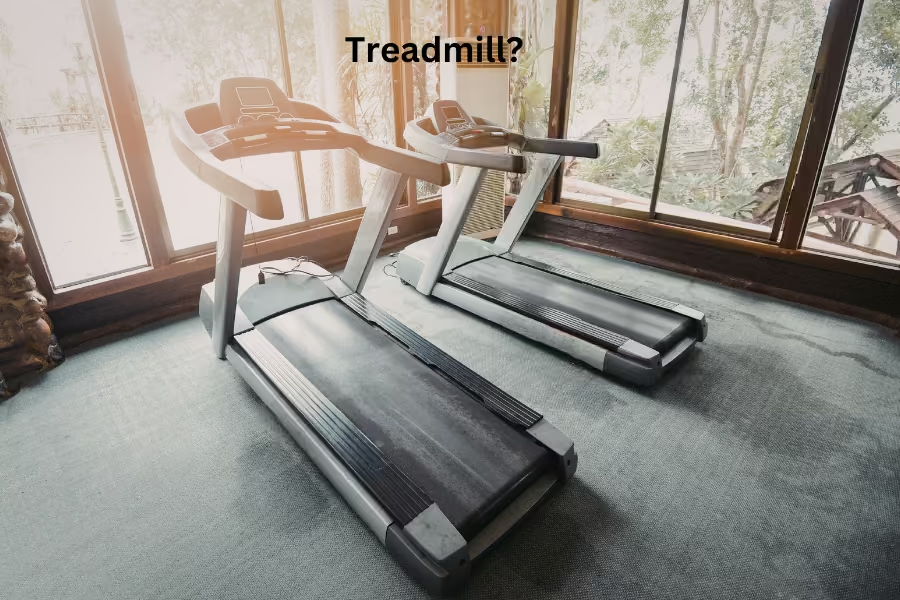
Parts of a treadmill
A treadmill is comprised of different parts that work together to provide a smooth running or walking experience. It has structural, mechanical, and electronic components.
Structural Components
- Frame
This is the foundational structure, usually made of heavy aluminum or steel to support your body weight and hold the other parts in place.
- Deck
Usually made of composite like MDF, a deck is a solid board underneath the belt. The purpose of a deck is to absorb impact, and it is well cushioned to reduce impact on your joints.
- Uprights/Handrails
Handrails are included on treadmills to ensure users are well-supported. Also, the handrails have user-friendly controls that ensure your workout is smooth.
Mechanical Components
- Running belt
A running belt is the cushioned surface used for jogging or walking. The belt loops continuously over two rollers. It is usually 16-18 inches wide and at least 54-60 inches long for enough stride.
- Motor
A motor is a crucial component located at the front. It converts electrical energy into mechanical force to move the belt. In short, it is the heart of the treadmill.
- Rollers
A treadmill has front and rear rollers that support and guide the running belt’s movements. The front roller drives the belt, while the rear roller keeps it centered.
- Shock absorption system
These integrated cushioning mechanisms in the deck reduce impact on your joints during a workout. Shock absorbers use springs, elastomer cushions, or air-based technology to provide a smoother running surface. However, for the shock absorbers to work efficiently, they must be replaced every 6 to 12 months, as they lose elasticity over time.
Electric Components
- Display Panel
The display panel is the user interface that shows all the controls. It allows you to adjust the speed and incline or choose from different workout programs. Also, it shows metrics such as calories burned, time, distance, and heart rate.
- Sensors
A treadmill has various sensors, including heart rate and speed monitors, that provide reliable data to the control console.
Other Important Components
- Cooling fan – blows air towards the user for comfort
- Incline motor – helps raise or lower the deck for hill training
- Transport wheels – for moving the machine
- Speakers/Bluetooth – mostly for music, for trainers who love listening to music while working out
- Folding mechanism – allows for storage even in tight spaces
- Safety key – it stops the treadmill in case the user falls or loses balance.
What are the Advantages of a Treadmill?
- Improves Cardiovascular Health
A treadmill is a good workout tool for strengthening your heart and lungs. When you walk or jog regularly on a treadmill, you will reduce the risk of heart disease, improve circulation, and increase heart efficiency.
- Feels Natural
Compared to an elliptical machine, a treadmill feels livelier and engaging. We are used to walking and jogging. So, when you get on a treadmill, the feeling is the same as running outdoors. A treadmill allows you to set a precise pace that you can maintain without any interruption.
- Multiple Controls
The versatility a treadmill offers cannot be compared to any other fitness tool. Whether you want to run uphill or jog, you can dial in the exact incline and speed for your workout. The more controls you have, the easier it will be to reach your fitness goals. Because you can easily control the speed and incline, a treadmill is suitable for high-intensity interval training (HIIT). HIIT workouts are ideal for reducing body fat, burning calories, and improving cardiovascular fitness.
- Great for Building Leg Strength
Walking or running on a treadmill is a great way to strengthen your leg muscles. Using incline settings, resistance, and speed intervals, you can target the hamstrings, quadriceps, calves, and glutes. In addition to leg muscles, it can strengthen your glutes and hip flexors over time.
- Low-impact option for joint safety
Unlike outdoor training, where surfaces can be rough or uneven, a treadmill offers a smooth, shock-absorbing surface. The smooth surface helps reduce stress on the hips, ankles, lower back, and knees. This makes it a great option for beginners, older adults, anyone with joint sensitivity, and people recovering from injury.
- Easy progress tracking and goal setting
Modern treadmills are designed to display time, distance, calories burned, and heart rate. This display helps you track improvements, set weekly goals, and stay motivated. Seeing real numbers can be encouraging and help you measure progress.
What are the Disadvantages of a Treadmill?
- It is not easy on the joints
When you run on a treadmill often, your knees can start being affected. Every time you run or jog, your knees have to bear your body weight. To reduce the risk of knee injury, use proper running shoes, avoid overdoing it, and use a slight incline to change the impact on your knees and other joints. Also, if your joints hurt when running on a treadmill, try switching to gentler cardio workouts. For instance, you can try biking or swimming.
- Limited muscle engagement
Although a treadmill is great for building strength in your leg muscles, glutes, and hip flexors. It doesn’t target many muscle groups like an elliptical does. An elliptical enables you to work on your back, shoulders, arms, and chest, as well as the muscles in your lower body. Because you can pedal in reverse motion, an elliptical helps you isolate certain muscles, which is tricky to do with a treadmill.
- It can be noisy
When a treadmill is used at high speed, it can become noisy. When using the machine, you will hear a low, consistent hum, louder thuds, or squeaks due to mechanical issues such as worn-out belts. To reduce the noise, the treadmill should be maintained regularly. Also, it should be on a flat rubber surface to absorb vibrations.
Who Should Use a Treadmill?
A treadmill isn’t just for learners. It can be used by different people depending on fitness level, goals, and lifestyle. You can use a treadmill if:
- You are a beginner starting your fitness journey
- Anyone with a tight schedule. A treadmill allows you to perform quick workouts even early in the morning or late evenings
- An older adult looking for gentle cardio
- Anyone looking to lose weight and improve their cardiovascular health
- If recovering from an injury.
Who Should Not Use a Treadmill?
- People with serious joint pain or joint injuries
- Children under the age of 14 years
- Anyone with poor balance and body coordination issues
- If you are experiencing chest pain or heart disease
- Anyone with severe arthritis. The repetitive motion can increase inflammation and stiffness, which takes time to recover
- If you experience dizziness or fainting. A treadmill requires constant awareness and stability to prevent you from falling.
Are Treadmills and Elliptical Machines Safe to Use?
When used correctly, these fitness machines are safe. When using a treadmill, always use the safety key to shut the machine off instantly in case you fall. Avoid improper use, such as stepping on a moving belt, as it can cause severe friction burns or injuries. Also, warm up properly. A good warm-up gets your muscles and joints ready to work, reducing the risk of injury. Also, ensure you stretch after working out.
When using an elliptical, focus mostly on good form. Your posture should be upright, and the core should be tight throughout the movement. If you are not sure how to use an elliptical safely, ask a certified trainer to give you a demonstration. This will help eliminate guesswork.
If you feel dizzy or lightheaded, stop using the elliptical or a treadmill. These two machines require body balance and coordination. Even the simplest fall can lead to injuries
Wrapping Up
The elliptical and the treadmill are both good workout machines. The answer to which machine is best will depend on your individual needs. You can choose an elliptical if you want a joint-friendly option, a return-to-exercise option after injury, or a beginner-friendly machine that still burns calories.
If you want to train for outdoor running or target lower-body strengthening, a treadmill is a good option. Also, a treadmill can be great for athletes who love walking or running regularly.


